
The COVID-19 pandemic has transferred the educational process to the online sphere. As a result, educational website development is a tidbit for startup companies that want to build custom solutions to deliver and manage education courses and generate revenue.
This post will guide you through the educational web development process, discover core features, and more essentials.
The Most Popular Categories of Websites for Education
First off, you must choose the educational website category you intend to create. Learning platforms are often split into types according to the core audience and learning methods. Let’s look at each of them.
By Core Audience
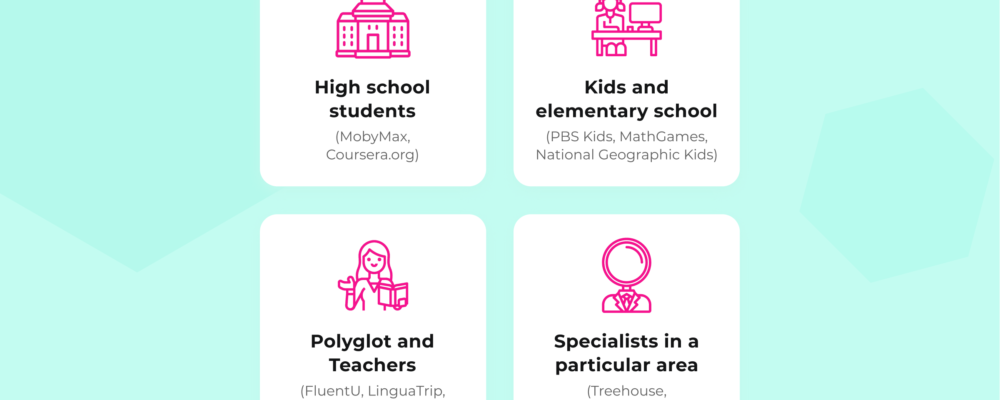
Before establishing a website for educational purposes, you should think about different target audiences. Thus, the platform may be divided into the following categories according to the said criteria:
By Learning Methods
What is the perfect way to create an effective educational platform? It is critical to choose the appropriate learning method. (e.g., games, videos, group education, and so on).
- Computer-managed instruction is a hybrid of software and typical classroom lessons. The solution offers students access to additional materials for their knowledge enhancement.
- Computer-assisted learning. Machines are utilized to control the educational process and access the contents in this learning approach. Students can select a course based on their interests and requirements (e.g., Coursera).
- Simultaneous online education. Using video calls and digital conversations (such as in Google Hangouts or Zoom), students from all around the world may attend classes together.
- Conversational e-learning. The foundation of this system is two-way communication between students and teachers. Tutors may use it to add new content and change their teaching approaches.
- Flexible online learning. The system examines the students’ learning patterns and actions to provide personalized learning materials for everybody.
The Critical Functionality For E-learning Website
Every educational solution has its own distinct voice. So how can you build a sustainable and easily-scaled learning platform? Try to provide valuable elements that will assist learners in solving challenges. We’ve highlighted the essential features that every learning website should have based on different roles below.
Teacher:
- Sign up/Sign out
- Login
- Course
- Students control
- Test
Student:
- Sign up/Sign out
- Login
- User profile
- Course page
- Menu
Parent:
- Sign up/Sign out
- Login
- Progress dashboard
- Course catalog
- Feedback
The question is, how much will such a website with all the implemented features cost? Its final price will depend on different factors (e.g., the Coursera MVP site costs approximately $54,750 – $62,500). But if you plan not to stop on a website building and need to find out the accurate website or mobile app development cost 2022, the specialists can calculate it only based on your project requirements.
Once you’ve made a profit, you may spend it on developing animation features to attract additional leads.
Building Stages For an Educational Website
As you’re working with a large volume of data that has to be structured, educational web creation requires extensive planning expressed in 6 below stages.
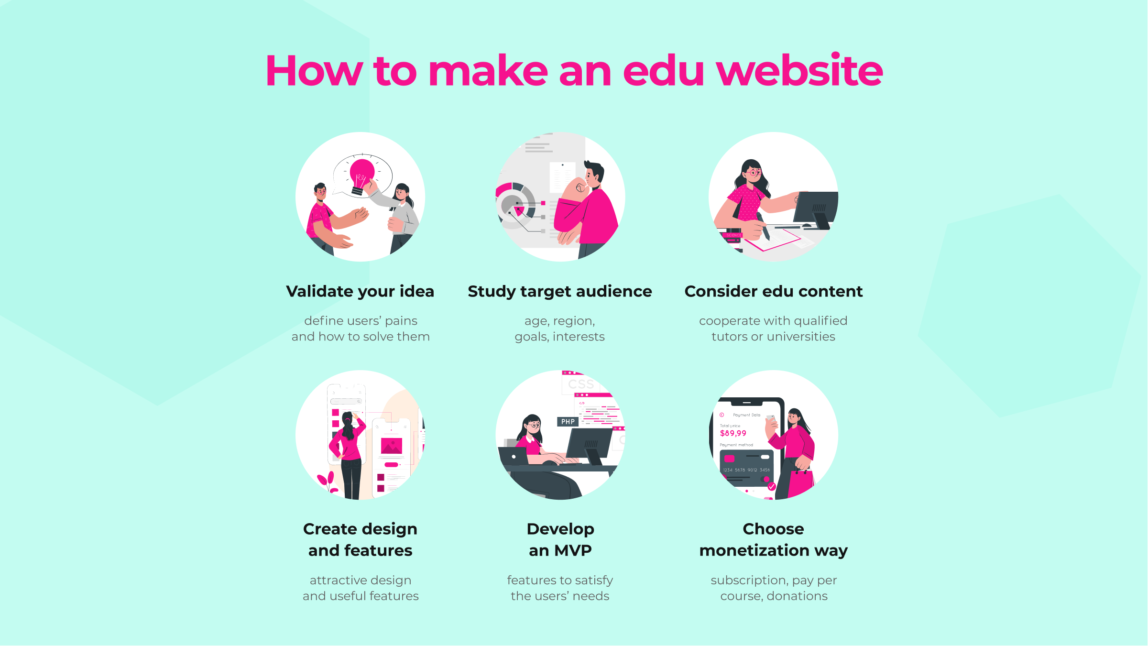
Verify Your Concept
Before launching your website, you must demonstrate the viability of your concept. How to do it? You must identify your target audience, identify weak spots, and forecast user expectations.
Research Your Core Market
Creating an educational website for everybody is pointless. So, examining your sector and defining your consumer persona are critical. It means determining their age, place of living, interests, favorite social media, and so on. Furthermore, you must follow the industry leaders to learn about their educational systems’ strengths and limitations.
Provide educational content on your website
To grab attention, it’s critical to create valuable and exciting learning content. You can work with skilled teachers or educational institutions as an alternative. For example, MasterClass (a world-leading e-learning platform) collaborates with celebrities like Marc Jacobs or Annie Leibovitz to create meaningful content.
Select a Design and Functionality
Starting the building stage with web development services rendered by skilled IT professionals, remember that you should develop a simple and user-friendly website. You may collaborate with UI/UX designers to create the desired interface.
Create a website MVP
The Minimum Viable Product (MVP) includes only the vital functionality to solve users’ critical problems. It’s an excellent way to test the waters, acquire early feedback, and adjust product strategy depending on business data and user perceptions. Furthermore, since stakeholders get a functional product with the MVP version, you may quickly acquire first financing.
Use monetization approaches
Your educational platform is already generating income for you. Monetize your learning website by providing donations, a subscription-based payment strategy, or a one-course pay.
Wrapping Up
We’ve provided you with insights into the educational web development process. If you want to learn more and get more answers to your questions, a skilled software development company can assist you. The IT experts will help you choose a tech stack for your future educational project, make up a functionality list, and create a modern and profitable educational site.